Watch the video
The Weimar Republic’s Economic Turmoil and Its Postal Reflection
The Weimar Republic, born out of the ashes of Imperial Germany after World War I, faced one of the most severe economic crises in modern history: hyperinflation. Between 1921 and 1923, the value of the German mark plummeted[1], with prices doubling every few days. This economic cataclysm left an indelible mark not only on society and politics but also on the day-to-day functioning of institutions — including the postal system. Postage stamps, often overlooked as simple functional items, became poignant artifacts documenting the turbulence of this period.
The Genesis of Inflation Stamps: Rapid Denomination Changes
As hyperinflation accelerated, the German postal authorities faced an unprecedented challenge[2]. Stamps denominated in marks quickly became worthless within weeks or even days. To keep pace, the Reichspost issued stamps with ever-increasing face values. The inflation stamps of the early 1920s reveal an extraordinary sequence of surcharges and new issues, often with denominations soaring from mere pfennigs to millions of marks.
Initially, the postal service responded by overprinting existing stamp stocks with higher values. For example, the 10-pfennig stamps were overprinted to 1,000 marks, then 10,000 marks, and so forth. In some cases, stamps were revalued multiple times within months, reflecting the rapid devaluation of currency. This process was not only a logistical feat but also a visual representation of economic collapse.
Notable Series and Designs
The inflation stamps featured a variety of designs, from traditional German motifs like the imperial eagle to allegorical figures symbolizing commerce and industry. Among the most famous are the “Germania” series, originally issued in 1900 but extensively overprinted during the inflation period. The rapid surcharging on these stamps provides a timeline of the inflation’s severity.
Anecdote: The 1923 One Billion Mark Stamp
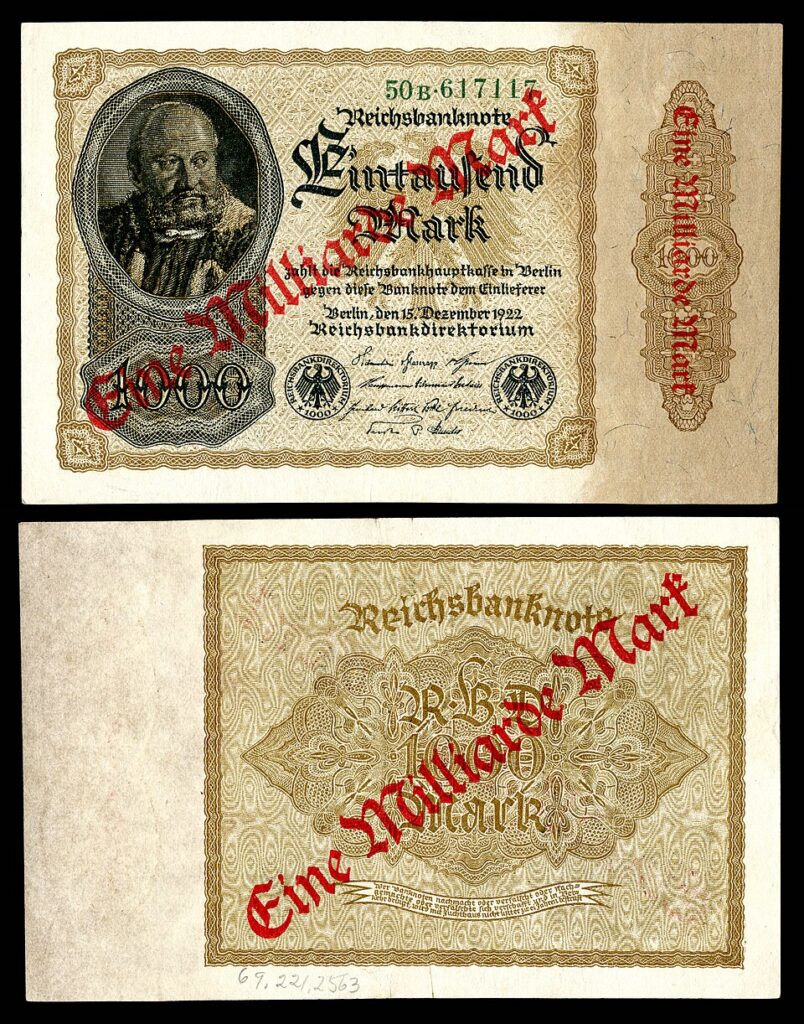
One of the most striking examples is the 1923 one billion mark stamp[3]. Issued in November 1923, as prices sky-rocketed, this stamp cost more than most monthly wages. According to postal records, this stamp was used on letters that effectively cost the sender a small fortune, underscoring the absurdity of the inflation. Collectors today prize these issues not only for their rarity but for their vivid illustration of economic despair.
Hyperinflation’s Impact on Postal Operations
The inflation did not only affect the stamps’ face values but also the entire postal system’s operations. Postal clerks had to manage continuous changes in postage rates, often updating rates daily. This chaos is reflected in the variety and quantity of provisional and emergency stamps issued during this period.
Additionally, the cost of mailing a simple letter increased from a few pfennigs to billions of marks. This made everyday postal communication a challenge, and often forced businesses and individuals to ration or forego postal services. The stamps and postal markings from this era provide a tangible record of how hyperinflation disrupted ordinary life.
Practical Tip for Philatelists
For collectors interested in the Weimar inflation stamps, it is crucial to verify the authenticity of overprints and surcharges. Due to the high demand and complex issuance, many forgeries and reprints have circulated. Consulting specialist catalogs such as Michel Germany or the Scott Specialized Catalogue[4] can provide guidance. Additionally, provenance and expert certification add value and credibility to these fragile historical documents.
The End of Hyperinflation and Postal Stabilization
The hyperinflation crisis effectively ended with the introduction of the Rentenmark in late 1923, stabilizing the currency. Correspondingly, postal rates and stamp denominations reverted to more manageable levels, and new definitive stamps were issued.
This transition is clearly marked in philatelic collections: the inflation stamps serve as a stark contrast to the more stable issues that followed. For historians and collectors alike, this shift encapsulates a critical turning point in German history.
Anecdote: Collector’s Legacy from the 1920s
One notable collector, Ernst Sommer, began assembling his Weimar Republic inflation stamps in 1924[5], immediately after the crisis. His collection, now housed in a Berlin museum, contains a comprehensive series of inflation surcharges, postal stationery, and covers with rare postmarks. Sommer’s meticulous annotations provide invaluable insights into postal rates and economic conditions, highlighting how personal passion can preserve national history.
Stamps as Cultural and Historical Artifacts
The inflation stamps of the Weimar Republic transcend their utilitarian purpose. They embody a nation’s struggle with economic collapse, political instability, and social upheaval. Each surcharged stamp tells a story of adaptation and resilience amid chaos.
For philatelists, these stamps offer more than mere monetary value; they are tangible connections to a transformative period. Exhibitions featuring these stamps often include contextual materials such as newspapers, photographs, and official decrees, providing a multi-dimensional understanding of the era.
Practical Tip for Display and Preservation
Given their age and fragile nature, inflation stamps require careful handling. Collectors should use acid-free mounts and store stamps in climate-controlled environments to prevent deterioration. Displaying them alongside explanatory captions enhances their educational impact, inviting viewers to appreciate the intersection of art, economics, and history.
Conclusion
The 1920s Weimar Republic inflation stamps stand as vivid, visual chronicles of hyperinflation’s devastating impact on German society. Through rapidly changing denominations, emergency surcharges, and distinctive designs, these postage stamps capture a moment when currency lost meaning and everyday life was transformed. For historians, philatelists, and art lovers, these small pieces of paper offer profound insights into one of the 20th century’s most dramatic economic episodes.
Collecting and studying these stamps not only preserves an essential chapter of German history but also honors the enduring human stories embedded within their fragile surfaces.
Visual Summary — Article in Motion
References
- Encyclopaedia Britannica, "Weimar Republic", 2023 https://www.britannica.com/event/Weimar-Republic
- Michel Deutschland Spezial Katalog, 2024 Edition
- German Postal Museum, "Weimar Inflation Stamps Collection", 2022 https://www.deutschepost.de/en/inflation-stamps.html
- Scott Specialized Catalogue of German Stamps, 2023
- National Museum of German History, "Ernst Sommer’s Philatelic Legacy", 2019 https://www.dhm.de/en/collections/philately