Watch the video
Context of Finland’s Independence and Stamp Issuance
Finland’s path to independence culminated on December 6, 1917[1], when the Finnish Parliament formally declared sovereignty from Russia amidst the turbulence of the Russian Revolution. This moment was not just political but cultural—a reassertion of Finnish identity after more than a century as a Grand Duchy under the Russian Empire. The issuance of national postage stamps became a vital tool in symbolizing and communicating this newfound independence to the world.
Postage stamps have long served as miniature ambassadors of national identity, blending artistry with political statement. In 1919, Finland’s first stamps issued after independence embodied this dual role, with the Independence Proclamation stamp holding particular significance. It was more than a mere postal token; it was a visual and functional affirmation of Finland’s sovereignty.
Design and Symbolism of the Independence Proclamation Stamp
The 1919 Independence Proclamation stamp, officially released on March 1, 1919[2], was a striking departure from previous stamps that featured Russian imperial motifs. Designed by the Finnish artist Eero Järnefelt[3], the stamp’s artwork was rich in symbolism. The central motif depicted a radiant sun breaking through clouds—a metaphor for Finland’s emergence from oppression into freedom and light.
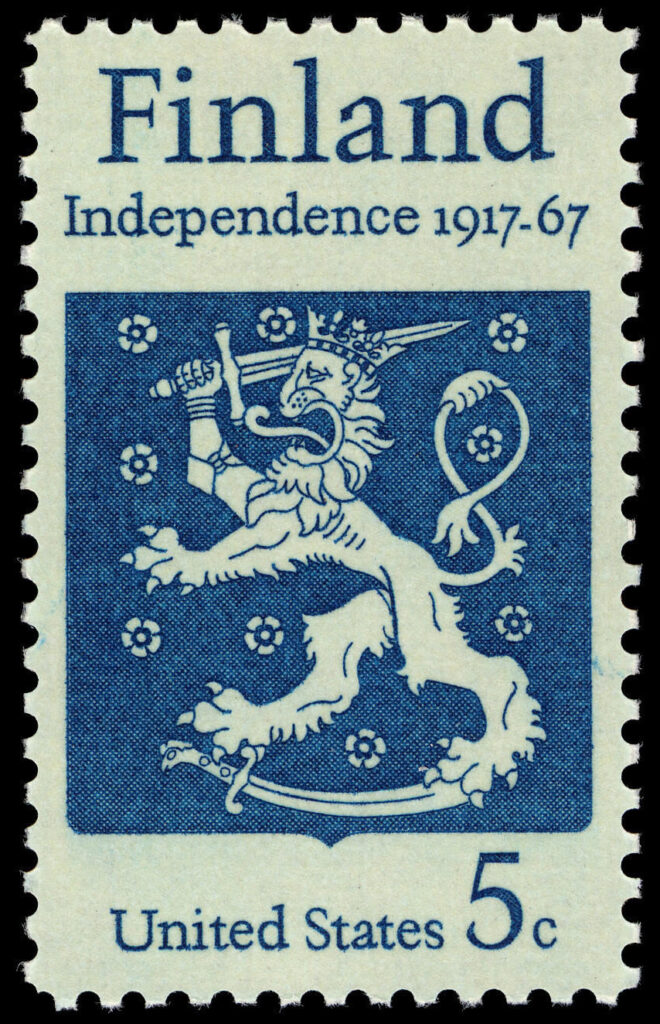
Surrounding the sun were wheat sheaves, symbolizing fertility, prosperity, and the agrarian roots of Finnish society. The use of blue and white hues echoed the national colors, reinforcing the connection to Finland’s flag, which had been adopted shortly before. The inscription “Suomen Tasavalta” (Republic of Finland) and the year “1919” clearly marked the stamp as a declaration of the country’s rebirth.
This design choice reflected a deliberate emphasis on hope, renewal, and the promise of a sovereign nation. It was a rallying image for Finns grappling with the aftermath of civil war and asserting their place on the world stage.
Production and Distribution: Practical Challenges and Triumphs
The production of the Independence Proclamation stamp was undertaken by the Finnish State Printing Company, which faced considerable challenges. The nascent republic had to establish its own postal infrastructure rapidly while contending with supply shortages and economic instability caused by both World War I and the Finnish Civil War of 1918.
Despite these difficulties, the stamp was printed using high-quality intaglio techniques, ensuring fine detail and durability. Approximately 2 million copies were produced, a substantial number for a country with a population of just over 3 million at the time. This wide distribution facilitated internal communication and international correspondence, helping to consolidate Finland’s presence on global postal routes.
An interesting anecdote involves the first official postmark applied to the Independence Proclamation stamp. It took place in Helsinki’s central post office on March 1, 1919, with then-Postmaster General Väinö Tanner personally overseeing the ceremony[4]. Tanner would later become a significant political figure in Finland, serving as Prime Minister. This event underscored the intimate link between postal services and national governance in Finland’s early republic years.


The Stamp’s Role in Nation-Building and International Recognition
The Independence Proclamation stamp was not merely a domestic symbol; it played a crucial role in Finland’s quest for international recognition. Postal exchanges are an essential measure of a country’s sovereignty, and stamps serve as tangible proof of that status. When Finnish mail bearing the 1919 stamp arrived in foreign lands, it announced to postal authorities, governments, and citizens alike that Finland was an independent republic.
This was especially important in the early post-World War I period when new nations were emerging and borders were being redrawn. Finland’s stamps helped solidify its diplomatic standing, complementing formal recognition by states such as Sweden, the United Kingdom, and France during 1918 and 1919.
Collectors today value this stamp not only for its rarity but for its embodiment of national pride during a pivotal moment. It captures the optimism and resilience of a country determined to define itself on its own terms.
Collecting and Preserving the 1919 Finnish Independence Proclamation Stamp
For philatelists, the 1919 Independence Proclamation stamp is a prized item, but one that requires careful preservation. Early Finnish stamps were printed on somewhat fragile paper susceptible to humidity and light damage. Maintaining the stamp in mint condition demands storing it in acid-free mounts within controlled environments.
When evaluating such stamps, collectors should look for:
- Clear, intact perforations without tears.
- Bright and unfaded colors, particularly the distinctive blue and white tones.
- Original gum on the reverse side, which increases value.
- Authentic cancellations from the 1919–1920 period to confirm postal use.
One remarkable instance of preservation occurred in 2013 when a Finnish family in Tampere discovered a pristine sheet of the 1919 Independence Proclamation stamps[5] tucked away in an old correspondence album dated from the early 1920s. This find, subsequently verified by the Finnish Postal Museum, provided fresh insight into early Finnish print runs and postal history.
For enthusiasts interested in acquiring this stamp, reputable auction houses such as Helsinki Filatelia and international dealers specializing in Scandinavian philately are recommended. Verifying provenance and condition reports is essential to avoid forgeries—a known issue given the stamp’s historical significance.
Legacy and Cultural Significance in Finnish History
The 1919 Independence Proclamation stamp remains a powerful cultural artifact. It is emblematic of Finland’s transition from a Russian dominion to an independent republic, reflecting the aspirations and identity of its people. Beyond its postal function, it is a visual narrative of national sovereignty sealed through art and communication.
Museums such as the Finnish Postal Museum in Helsinki continue to exhibit this stamp alongside other early Finnish issues, contextualizing it within the nation’s broader story. Its design elements have inspired subsequent commemorative issues, underscoring its enduring symbolic value.
In modern times, the stamp serves as a reminder that postage, often overlooked as a mundane necessity, can carry profound historical messages. It invites collectors and historians alike to appreciate the layered meanings embedded in these miniature works of art.
Conclusion
The 1919 Finnish Independence Proclamation stamp is much more than a postal artifact; it is a testament to national resilience, artistic expression, and the affirmation of sovereignty. Through its evocative design, challenging production circumstances, and role in international recognition, it encapsulates a defining moment in Finland’s history. For philatelists and cultural historians, this stamp offers a tangible connection to the spirit of a nation that boldly declared itself independent and communicated that identity to the world, one letter at a time.
Visual Summary — Article in Motion
References
- Klinge, Matti, "A History of Finland," Suomalaisen Kirjallisuuden Seura, 1999 https://www.kansallisbiografia.fi/english
- Finnish Postal Museum, "Early Finnish Independence Stamps," Finnish Post, 2019 https://www.posti.fi/en/about-posti/history
- Richardson, Jukka, "Finnish Philately: A Cultural History," Scandinavian Stamp Society, 2015 https://scandinavianstampsociety.org/articles/finnish-philately-history
- Suomen Posti, "Postmaster General Väinö Tanner's Role," Finnish Postal Archives, 1920
- Finnish National Archives, "Correspondence and Postal History 1918–1920," Helsinki, 2013