Watch the video
Introduction to North Korean Philately
North Korea, officially known as the Democratic People’s Republic of Korea (DPRK), is one of the most secretive and enigmatic countries in the world. Yet, one fascinating lens through which to explore its state ideology and political narratives is its postage stamps. These small pieces of paper, often overlooked by casual observers, serve as vibrant windows into the nation’s propaganda, art, and diplomacy. The DPRK’s stamps are meticulously crafted to project carefully controlled images of leadership, socialism, military strength, and cultural pride. For philatelists and historians alike, North Korean stamps offer a compelling study of how a state uses philatelic issues as tools for internal control and external messaging.
The Historical Context of North Korean Stamps
North Korea issued its first stamps in 1946, shortly after the establishment of the DPRK in 1945 following the end of Japanese colonial rule. The early issues reflected themes of liberation, rebuilding, and socialist revolution. Over the decades, the themes evolved but remained deeply intertwined with the country’s political ideology.
The state’s control over media and messaging meant that stamps became more than just functional postage; they were miniature billboards extolling the virtues of the Kim dynasty, the Workers’ Party, and the Juche ideology. The stamps also commemorated important national events, anniversaries of the Korean War, and iconic symbols such as the Paektu Mountain, widely regarded as sacred in DPRK mythology.
Iconography and Propaganda in Stamp Design
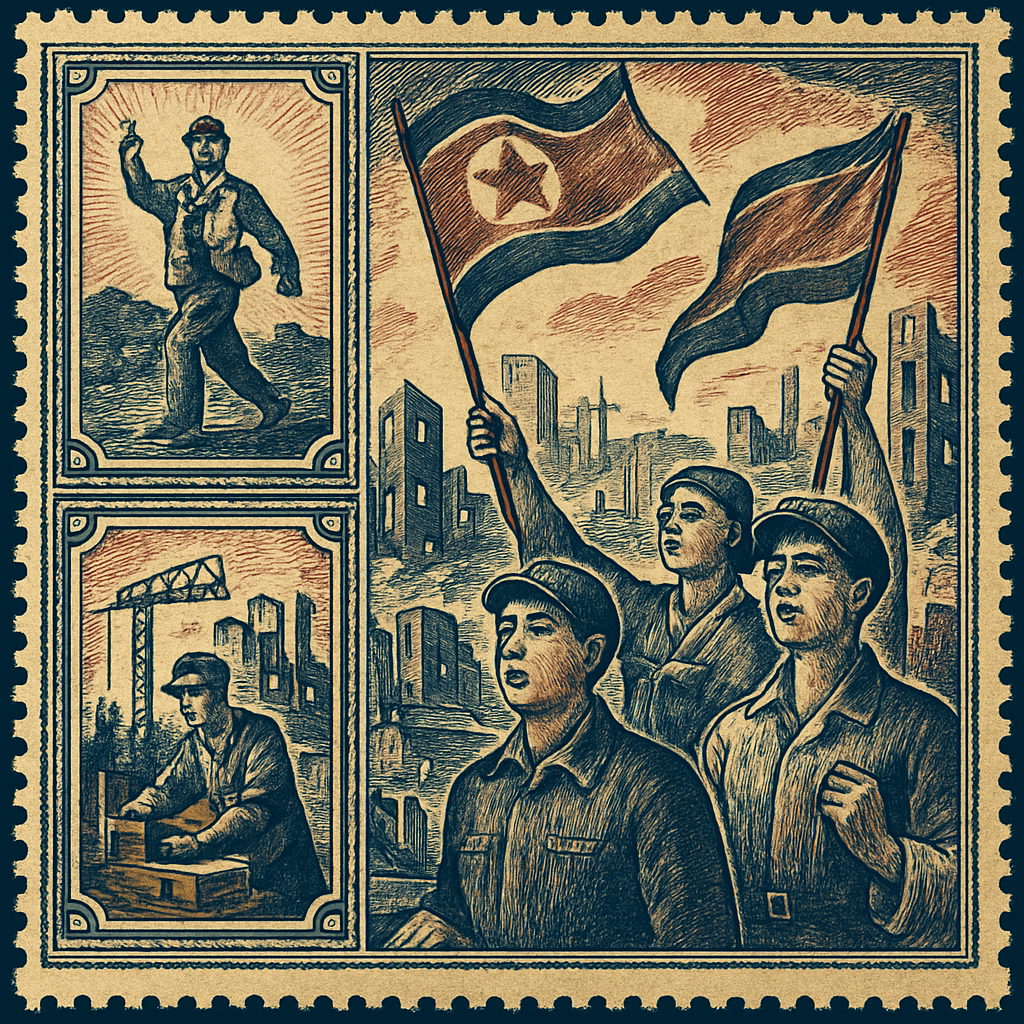
The DPRK’s stamps are notable for their rich, vivid colors and detailed illustrations, often blending realism with socialist realism art styles. The iconography is carefully selected to reinforce state narratives.
The Cult of Personality
One of the most dominant themes in North Korean stamps is the cult of personality surrounding the Kim family. Kim Il-sung, the country’s founder, and his successors Kim Jong-il and Kim Jong-un are frequently featured, sometimes alone, sometimes alongside imagery symbolizing their leadership.
- Portraits and Statues: Large, dignified images of the leaders affirm their central role in the nation’s identity and destiny.
- Symbolic Scenes: Stamps depict the leaders engaged with workers, soldiers, and children, projecting an image of benevolent guardianship.
- Juche Ideology: Many issues include slogans and iconography related to self-reliance and ideological purity, reinforcing the leader’s role as the guide of this philosophy.
Military Strength and National Defense
Given the DPRK’s militarized posture, stamps frequently highlight the Korean People’s Army, missile capabilities, and historic battles. These images serve to instill national pride and underscore the regime’s emphasis on defense and sovereignty.
Cultural and Historical Themes
Beyond politics, North Korean stamps celebrate traditional Korean culture, revolutionary history, and natural landmarks. These issues work both domestically to cultivate patriotism and internationally to craft an image of a proud, resilient nation.
Diplomatic and Psychological Dimensions
While the internal messages of DPRK stamps are overt, their international dimensions are equally strategic. North Korea issues stamps that commemorate international events, friendly nations, and global causes, often as a form of soft diplomacy.
Philatelic Diplomacy
By issuing stamps featuring foreign leaders, international organizations, or global anniversaries, the DPRK seeks to establish goodwill and recognition on the world stage. These issues target collectors worldwide, promoting a narrative of peaceful coexistence and engagement, even as the regime remains isolated politically.
Psychological Impact on Collectors and Audiences
The elaborate and colorful nature of many DPRK stamps appeals to international philatelists, who may be drawn by the exotic and rare nature of these issues. This fascination provides the regime with a subtle channel for disseminating its ideology. The stamps become tools for psychological influence, presenting a controlled image of North Korea that contrasts with often negative media portrayals.
Collecting North Korean Stamps: Tips and Considerations
For philatelists interested in North Korean stamps, there are unique challenges and opportunities. The DPRK issues a large number of stamps annually, many of which are produced primarily for export to generate hard currency. This has led to a proliferation of thematic and commemorative issues, some of which are considered less valuable by specialists.
Identifying Genuine Issues
- Official Catalogs: Refer to specialized catalogs such as the Scott Catalogue or the Michel for accurate listings.
- Watermarks and Printing Details: North Korean stamps often have specific printing methods and watermarks that help authenticate them.
- Beware of Overprints and Reprints: Some issues have multiple versions, including souvenir sheets and reprints, which vary in value.
Popular Themes for Collectors
- Leaders and Personality Cult stamps
- Military and defense-related issues
- Cultural heritage and national anniversaries
- International commemoratives and diplomatic themes
Storage and Display
Due to their vibrant colors and detailed designs, North Korean stamps are ideal candidates for framed displays. High-quality, UV-protected frames preserve the vivid artwork and allow collectors to showcase the stamps as both historical artifacts and visual art pieces.
Interesting Anecdotes from DPRK Philately
- In 1973, North Korea issued a set of stamps commemorating the 100th birthday of Vladimir Lenin, reinforcing ideological ties with socialist movements worldwide.
- The 1984 “Space Exploration” series depicted rockets and cosmonauts, illustrating North Korea’s aspiration to be seen as a technologically advanced nation.
- A rare stamp issued in the early 2000s featured Kim Jong-il with a white horse, symbolizing his legendary status in North Korean folklore.
The Artistic Merit of North Korean Stamps
Beyond their political and ideological functions, North Korean stamps are notable for their artistic qualities. The use of bright, saturated colors, intricate line work, and dynamic compositions reflect the influence of socialist realism while incorporating distinctly Korean aesthetics. Many stamps are produced with high craftsmanship, making them prized pieces for collectors interested in art as well as history.
Visual Summary — Article in Motion
Conclusion
North Korean stamps are far more than mere postage; they are powerful tools of statecraft, propaganda, and diplomacy. Through their imagery and themes, they reveal the priorities, narratives, and self-perceptions of the DPRK. For collectors and historians, these stamps offer a unique and multifaceted insight into one of the world’s most secretive regimes. Whether admired for their artistic value or studied for their ideological content, North Korean stamps remain compelling windows into the country’s complex identity under the red sun.